Putting the Pieces Together
Fleet Defense Light Carrier:
A light carrier that can provide combat air patrol and AEW is a force multiplier for fleet carriers. By taking over the air defense role, the fleet carrier doesn’t have to keep its landings strip free to cycle CAP and AEW, opening up more deck parking space for a larger air wing and larger faster alpha strikes that would be the decisive long range strike capability in a peer naval war. It also allows you to provide air cover for amphibious landings or smaller task forces without pulling the fleet carriers away from long range strike duty.
Because it only has to do local air defence, it can use a specialized air wing with long endurance autonomous helicopter AEW and STOVL drone fighters that can operate effectively from a smaller straight deck ship. Having maneuvering room and being able to set up two alert fighters drives an approximately 100 ft wide deck, so you end up with an 800-900 ft long ship, and since it isn’t spotting strike packages on the flight deck, it only really needs the forward 400 ft for its air wing.
Air Warfare Cruiser:
The other primary component of modern fleet air defense is the air warfare cruiser with large radars to track and engage incoming threats, flag accommodations for commanding the task force’s air warfare assets, and a deep magazine for shooting down incoming missiles. Ideally, a state of the art air warfare cruiser should also be able to track ballistic missiles at long range, which requires a very large radar and therefore a wide enough ship to fit it on the superstructure without crowding out other important parts like a powerful EW suite and infra-red sensors.
Large Caliber Naval Guns
The most expensive part of an air-to-air missile is the rocket motor because it has to survive 40+gs while minimizing weight, and function correctly under said g loading while the motor is actively burning. The electronics on the other hand are all solid state, and the warhead inherently has a high structural mass, so they have relatively little cost penalty for surviving high G loads. Gun based air defenses outsource the motor to a gun barrel that you can build as heavy as you want, which allows the projectile to be a steel dart with only the g tolerant parts, and dramatically cheaper. A battleship caliber gun can throw a sabot round with enough energy to engage air targets at a range of at least 200 miles, similar to the SM-6 missile, for a fraction of the cost.
A lower cost SM-6 equivalent, and the 200-mile range 1000 lb glide bombs, and 500+ mile range low-cost ramjet cruise missiles that could also be fired from a battleship caliber gun also give the ship a short and medium range strike capability against ships and land targets that doesn’t demand the cost per shot of conventional missiles or the crew and setup time of a carrier air wing, which makes it extremely cost effective for providing continuous, responsive, low intensity fire support and defending a place or strike group from enemy surface combatants.
Why put them together:
The light carrier and air warfare cruiser are synergistic, providing a full solution for fleet air defense, and since a light carrier would never be operating without an air warfare cruiser and both require a wide and tall ship but not its full length, it’s cheaper and uses less crew to combine them on a single ship.
The resulting ship is large enough to mount large caliber naval guns instead of most of its VLS banks to provide a significantly lower cost per shot option for long range air defense that’s easier to reload at sea, supporting the air defense capabilities, and adds an option for blasting any surface ships that get too close without using expensive VLS missiles or using strike aircraft that could be part of an alpha strike. The big guns also allow it to bring cost effective land attack and anti ship firepower to task forces and operations that don’t need a full fleet carrier.
What it Does for the Fleet
Supporting Fleet Carriers:
Having a battlecruiser provide air cover and short range anti-ship firepower lets you get 50% more carrier out of your fleet carriers by reserving their flight decks and air wings purely for long range strike missions. Between the force multiplier effect for the fleet carriers and replacing the air warfare cruiser, the ship and its air wing easily pay for themselves and then some as carrier escorts.
Supporting Amphibious Operations:
A battlecruiser that can provide air cover and responsive fire support within 300 miles allows an amphibious group to operate independently of the fleet carriers, saving said fleet carriers for long range strike and sea control missions. The battlecruiser’s guns are also much better at quickly and cost effectively handling the sporadic and unpredictable nature of naval fire support from beyond GMLRS range than expensive conventional missiles or strike aircraft.
Independent Operations:
A battlecruiser operating with a pair of frigates has 80% of the defensive and scouting capability of a full carrier strike group and extremely responsive and cost effective short to medium range firepower. That makes the small battlecruiser task force an incredible asset for cheaply defending critical sea lanes, whether that’s defending supply lines in a peer war or effectively suppressing a small nation or non-state actor that tries to disrupt global shipping.
For example, it would have been a perfect tool for dealing with the Houthis, being able to defend a large area from missiles and take out TELs before they can fire while being cheap enough and unimportant enough to stay on station as long as it takes for them to give up.
Designing the Ship
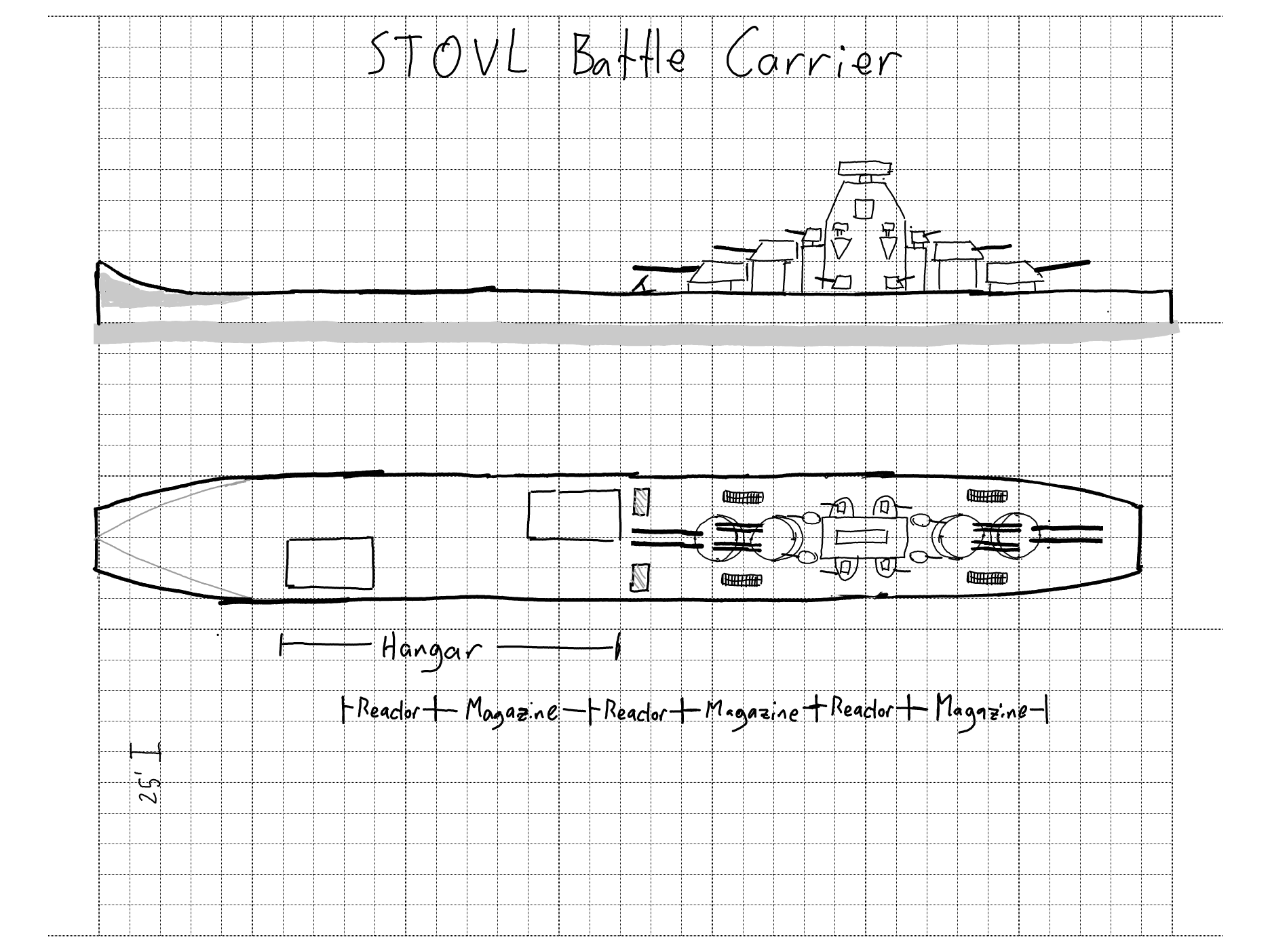
850 ft long x 106 ft wide
Hurricane bow with a ski jump
Power System:
As a long range capital ship with a lot of high power electrical systems, nuclear electric propulsion is an obvious choice for efficiency and damage tolerance. I think a ternary chloride salt cooled traveling wave reactor with a supercritical CO2 secondary loop is the ideal naval nuclear power plant, though that deserves a separate longer post of it’s own going into the technical reasons.
Weapons and Sensors
Fore and aft turret sets:
356mm twin turret on the main deck with 90-degree firing arc on each side (directly fore and aft is bad for the ship)
Centerline 155mm Quad turret super firing over over the main gun with a 270-degree firing arc. It’s the same diameter as the 356mm twin turret, and can fire advanced 155mm artillery shells, including subcaliber air defense shells like the hyper velocity projectile that can replace the ESSMs for short range air defense at lower cost with likely better performance against hypersonic and ballistic threats.
Port and Starboard 76mm Rapid Fire turrets equipped with DART shells for cheap point defense over the 155mm turret with 225 degree firing arcs each from the opposite beam to 45 over the shoulder
4 35mm revolver guns At the outboard edges of the deck, with one pair on either side of the 76mm guns and one pair on either side of the 356mm turret barrels’ travel position. being small CIWS systems, they don’t take up any space below deck.
Bank of 24 VLS cells on either side of the each main gun, giving 96 total cells. They’re positioned right underneath the main guns to protect them from the muzzle blast when the guns are fired.
Side Turrets:
2, 76mm Rapid Fire turrets equipped with DART shells for cheap point defense on each side of the superstructure with 180 degree firing arcs from directly forward to directly aft.
2 Air defense lasers on each side of the superstructure on sponsons directly above the 76mm guns
One 35mm revolver gun on each side at the outboard edge between the 76mm guns, not taking up any space below deck.
Sensors:
A Mid-Range engagement suite made up of the same AEIGS radars the burkes use and large aperture staring IRST telescopes for short and medium range air defense.
A single rotating long range ballistic missile defense on top of the superstructure is the cheapest way to track short and intermediate range ballistic and hypersonic missiles at extremely long ranges. Because it’s meant to track things beyond the 200-300 miles range of the fixed AEIGS radars, a 10 or 20 second revisit time is good enough even for tracking hypersonic missiles, and the rotation can be stopped to provide continuous tracking in one sector to guide an interceptor.
As a capital ship, it isn’t useful or cost effective to add any significant anti-submarine capabilities beyond a basic bow mounted sonar.
Aviation Facilities and Aircraft
Aviation facilities
Ski-Jump flight deck for helicopters and STOVL fighters, with port and starboard launch positions for two alert fighters.
Two 70 ft long x 40 ft wide aircraft elevators in the ends of the 260 ft long hanger, which can fit 4 AEW helicopters and a squadron of 12 STOVL drone fighters.
STOVL Drone Fighter
The drone fighter can be a similar design to some of the air to air CCAs being developed by the air force because it’s only missions are combat air patrol and scouting that can be controlled from the ship and don’t require extreme range or massive ordinance loads. Ideally it could carry a pair of AIM-260s internally for scouting or longer range interceptions, and mount 4, 70mm rocket pods with 7 APKWS II each on external pylons for combat air patrol to intercept small boats and low cost cruise missiles cost effectively.
Helicopter AEW
There isn’t any particularly good reason for a shipboard AEW aircraft to be manned since the flight profile is pretty simple and it stays close to the ship where all the command and control functions can be done comfortably from CIC. Going unmanned for a helicopter lets it give up autorotation capability for a more efficient rotor like the Boeing A160 Hummingbird that lets it cruise for much longer at much higher altitudes, giving you a highly effective AEW system that doesn’t need a CATOBAR carrier. I have some ideas for a more advanced helicopter that could fully match turboprop performance without using tiltrotors that would get in the way of conformal radars, but that’s it’s own discussion for a separate post.
 Matthew's Eclectic Engineering
Leave a comment