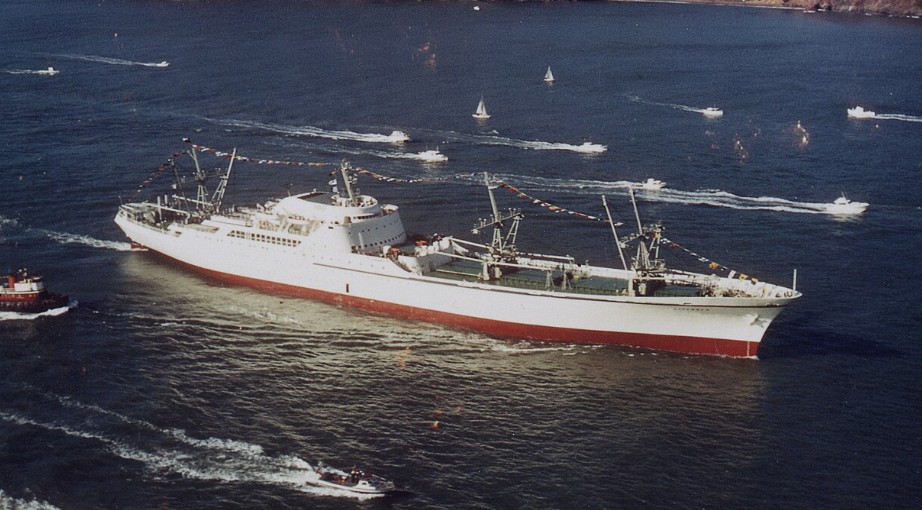
NS Savanah going to the Seattle world fair – Wikipedia/National Archives
The Potential and Pitfalls of Small Modular Reactors
Intro To Small Modular Reactors
Small modular reactors are, as the name implies, small nuclear reactors that produce less than 300 MW of electricity and are small enough for all the important parts like the reactor vessel to be built in a factory and transported by road. The idea is that unlike conventional reactors, they should get economies of quantity through production runs instead of bespoke projects built in place, and be easier to permit. There’s a lot of excitement around them as a source of carbon free distribute baseload power.
Why They Fail at Electricity Generation
Despite their real advantages, small modular reactors struggle to match conventional large nuclear power plants in terms of levelized cost of electricity. There two main issues they run into. One is that, like most industrial equipment, nuclear reactors get cheaper and lower maintenance per MW, and more efficient, the bigger they get. The other is that nuclear power has significant costs like nuclear technicians and security that scale much slower than linearly with the capacity of the whole plant. Those are what drives conventional nuclear plants to have multiple GW scale reactors on each site, and seem to still out weight the potential economies of production quantity of small modular reactors by a significant margin.
Where Small Modular Reactors Shine
That doesn’t mean that small modular reactors are useless, just that they aren’t a very good source of electricity when you have the option to hook up to the power grid or use solar and batteries.
One thing small modular reactors do really well is low carbon high temperature industrial heat. They only convert 20-40% of the heat energy they produce to electrical energy depending on the system, so their thermal output is 2.5-5x their electrical output. Once you get to high temperatures where heat pumps and cheaper thermal storage systems don’t work very well, that’s good enough to beat resistive heating even with a reactor that can only produce electricity at twice the market rate.
The other thing small modular reactors do really well is in places where you need consistent energy output for weeks instead of days between opportunities to recharge or refuel. The better small modular reactor designs come in at or below the cost of practical liquid fuels or such inefficiently utilized energy storage while being significantly smaller.
The Promise and Peril of Nuclear Powered Ships
Why Would You Want a Nuclear Powered Ship?
Based on the experience with nuclear powered ships in the US Navy, they’ve been expensive and difficult to build so far, and aren’t allowed in many ports, but the lifetime cost of the ship is lower than a conventionally powered ship and all the fuel it burns. With a reactor designed for commercial service and broader infrastructure to support it, that economic case might be possible on larger ships even before considering decarbonization, and they’re obviously cheaper than much more expensive synthetic fuels. The reactor is also significantly smaller and lighter than the engine and fuel it replaces because uranium is so energy dense, increasing the cargo capacity of a nuclear powered ship compared to a conventionally powered one (~5%).
When looking to decarbonize shipping, the other obvious question is, why not batteries? For smaller ships making shorter trips between port calls they’re the obvious answer, but for large ships on globe spanning routes, batteries have some issues. The first issue is the sheer quantity of batteries required, in the GWh range, significantly reduces cargo capacity (~10%) and buying them could rival the cost of a small nuclear reactor even with $50/kWh batteries. The other issue, partly driven by the first, is that unlike car batteries or a compact reactor, there’s no practical way to protect such a large battery bank in a ship from all plausible collisions or a grounding that breaks up the hull. That means accidents or fires for a large battery powered ship would be risking a massive battery fire that’s no less dangerous than the failure of a modern small nuclear reactor with far fewer plausible ways to mitigate the danger.
Why You Can’t Bring Them in to Ports
The greatest challenge for commercial nuclear ships is that they, quite understandably, aren’t allowed in most ports. Unlike a land based reactor, visiting a port necessarily puts the ship in the middle of a valuable industrial area and close to dense population centers. That makes any sort of accident in port much more dangerous than at a more remote nuclear plant. Doubly so because there’s no practical way to build a containment structure on a ship big enough to hold the entire volume of a light water reactor’s primary coolant loop boiling off in a steam explosion. And it’s hard for countries to be sure what the risks actually are because perfectly holding every ship to the same nuclear safety standards as the US Navy is almost impossible with the current scale and structure of global shipping.
Making the Worst Case Acceptable
In shipping, as in many other things, you have to assume that everything that can go wrong will go wrong, and that means making the worst case scenario no worse than the small oil spill that’s the worst case for current container ships. Part of that is dispelling myths about the dangers of radiation, and part of that is about engineering a reactor that fails safely.
A reactor meltdown shouldn’t be that scary, and on a ship even less so. If nuclear material, be it fuel rods or a molten core, get’s into the water, water is an incredible radiation shield, and radiation would only be above background within a few meters of the source. Unless it happened on a beach or in a channel you have to dredge, you might not even bother cleaning up a sunken reactor, and working under shallow water makes the cleanup a lot safer if you do.
On the engineering side, it means making a reactor that can’t explode no matter what, where small leaks aren’t a big deal, and nothing bad will dissolve if it gets in the water. That way even poor maintenance or dumb accidents can’t do much damage.
Engineering A Commercial Naval Reactor
Choosing a Primary Coolant
The coolant for the primary loop that runs through the core has to meet some basic safety requirements. It can’t require high pressures that might cause a steam explosion or related phenomena, small leaks have to be benign, it can’t burn or explode on contact with water, and it has to be non-toxic if it gets in the water. Going through the coolant options:
- Pressurized Water
- High pressure means steam explosions are possible
- small leaks can cut but aren’t toxic or flammable
- it’s water so it can’t burn or explode
- it’s water, so it isn’t toxic if it gets in the ocean
- Gas Cooled
- High pressure to get enough density means explosions are possible
- small leaks can cut but aren’t toxic or flammable
- Inert gas doesn’t burn or explode
- gas can’t get in the ocean because it’s gas
- Lead and Lead-Bismuth Alloy Liquid Metal
- Low pressure means no steam explosions
- lead vapors from small leaks are toxic
- Doesn’t burn or explode on contact with water
- lead corrodes and dissolves in saltwater, and is definitely toxic
- Sodium and Sodium-Potassium Alloy Liquid Metal
- Low pressure means no steam explosions
- small leaks burn, which could cause problems on a ship
- Sodium and Potassium explode on contact with water
- it’s not toxic in the ocean, but it does explode, so …
- Fluoride Salts
- Low pressure means no steam explosions
- small leaks just leave a frozen salt plug
- doesn’t burn or explode on contact with water
- dissolving large quantities fluoride salts in seawater can be locally toxic
- Chloride Salts
- Low pressure means no steam explosions
- small leaks just leave a frozen salt plug
- doesn’t burn or explode on contact with water
- common chloride salts are completely non-toxic in seawater
Based on the list, chloride salts are the only option that can’t burn, explode or poison anything due to poor maintenance or an accident. Since you want to stay within the operating temperatures of steel and more robust insulation materials, the best option is probably a majority zinc chloride salt with significant fractions of sodium chloride, potassium chloride, and magnesium chloride. It melts at a little under 200 C and has an upper temperature limit of around 700 C where the Zinc Chloride starts to boil.
Choosing a Reactor Cycle
The first thing to say is that despite using a salt primary coolant, dissolved fuel is right out. it takes small leaks from mildly to extremely radioactive, and the radioactive heavy metals could dissolve and disperse if it gets in the water. Solid fuel pellets on the other hand are made of oxides and carbides that keep the radioactive heavy metals contained where they can’t leak or dissolve in water.
Because the salt coolant isn’t a neutron moderator, that leaves the options of a fast spectrum or thermal spectrum reactor. Because as a civilian ship, it obviously can’t use weapons grade uranium, a conventional thermal spectrum reactor using low enriched uranium would have to be refueled every 1-2 years. Fast spectrum breeder reactors could use cheaper natural uranium, and simpler designs would only require refueling ever 5-10 years. some advanced fast spectrum reactors like the traveling wave reactor could last the 25 year lifetime of most container ships without unsealing the reactor vessel.
Other Considerations
Once you turn off the reactor, the coolant salt freezes without external heat, and you have to wait a couple days for the xenon-135 to decay before you can restart the reactor. Since port visits are usually well under 24 hours, you really don’t want to shut down the reactor at every stop. If you use an electric propulsion system instead of gears to connect the power turbines to the propeller, you can sell electricity to the grid while in port to keep the reactor running.
Summary
A small nuclear reactor is the cheapest emissions free way to power a huge cargo ship, and depending on the details, it has the potential to be on par with a fossil fuel power ship over it’s lifetime, or maybe even cheaper. To make them safe, it’s possible to design a reactor that you can abuse without hurting anything badly. With a good design, damage to the reactor is arguably less bad than a small oil spill, and easier to prevent because the reactor is so compact.
 Matthew's Eclectic Engineering
Leave a comment