The Threat of Cheap Missiles
Air Defence Saturation
Beyond sophisticated weapons or electronic warfare, the other way to beat air defences is saturation, or just throwing missiles at it until it runs out of interceptors. Air defence saturation has always been an important tactic, but missiles were too big and expensive for throwing more missiles than they have interceptors across the entire battlefield to be a viable strategy.
As electronics have gotten dramatically lighter and cheaper, much smaller and cheaper munitions like propeller-driven shaheeds that rely almost entirely on numbers have become a viable strategy. Even for higher-performance weapons, there are now jet-powered cruise missiles that are 1/5th the size and cost of a Tomahawk or Kalibur with similar ranges.
If small, low-cost cruise missiles let your adversary throw 4x or more missiles from the same launch platforms at the same ranges, saturating your air defences becomes much cheaper and easier. Shooting the archer (launch platform) isn’t a defence against saturation attacks anymore, either, when smaller, cheaper missiles can have the same range as the big, expensive ones.
Shot Exchange Ratio
The other strategic threat posed by low-cost cruise missiles is that they make the cost to intercept a missile, compared to the cost of said missile, much worse for the defender. Even relatively high-performance jet-powered low-cost cruise missiles are half the price of the cheapest conventional air-to-air missiles like the AIM-9, and the cheapest ground and surface-launched interceptors cost >5x what the AIM-9 does.
This poses an obvious long-term problem because an adversary can bleed out your defences and win even if you intercept every single missile they launch. Assuming some non-kinetic countermeasures, malfunctions, and destroying some missiles before they launch, a marginal cost per intercept of 2-3x the cost of the target is probably sustainable. Since you typically need two interceptors per target, even AIM-9s aren’t cheap enough for a war of attrition against low-cost cruise missiles.
The Existing Answers
Land- and Sea-Based Guns
One answer to cheap missiles has been to trot out the old anti aircraft artillary, and its modern descendants, because a bullet is a lot cheaper than a missile. Even the most expensive systems only need a few thousand dollars’ worth of bullets for each intercept, which is cheaper than anything bigger than a DJI Mavik.
The problem is, the guns are short-range, and as cheap as the bullets are, the guns are expensive. That means they can really only protect point targets because they don’t have the range to defend an area, and are too expensive to put everywhere. Their short range also means guns can’t thin out large attacks as they approach. That makes them much easier to overwhelm with more missiles than they can shoot down, even when there’s enough ammunition.
Land and sea-based guns are good for defending a valuable point target against smaller attacks or as a last line of defence, but aren’t a solution for large areas or big swarms of missiles. Systems like DART that blur the line between bullets and missiles are much more effective, and expensive, but still suffer from a short range that can’t provide area defence.
Interceptor Drones
Interceptor drones are a relatively new development for hitting cheap missiles with cheap battery-powered drones. Because they don’t need something expensive like a gun to launch them, interceptor drones are easy to spread out to defend large areas in spite of their short range. They’ve been so pervasive in Ukraine because it’s by far the cheapest way to do area air defence with what’s available right now.
The main limitation is that propeller-driven interceptor drones can’t reliably hit anything moving faster than a helicopter or a base model Shahed/Geran. Borrowing a rule of thumb from torpedo design, you have to be going at least 1.5 times the speed of your target to reliably close with and hit it, and cheap interceptor drones are limited to a little over 200 kts. That limits them to targets that aren’t going much more than 150 kts.
There are longer-range and/or jet-powered interceptor drones, but I suspect they’re a dead end because they start to get too expensive to compete with a reusable platform armed with air-to-ground missiles and still can’t chase down jet-powered missiles.
Air-to-Ground Missiles
A longer range solution that’s more amenable to air launch has been to repurpose precision air to ground missies like APKWS and Hellfire. Air-to-ground missiles are much cheaper than anti-aircraft missiles because they don’t have to be nearly as maneuverable, though still significantly more expensive than bullets or interceptor drones. APKWS costs less than a Shahed/Geran-type cruise missile and anything more sophisticated than that.
Weapons like APKWS are ideal as a bolt-on solution for tactical aircraft to defend large areas against high-end propeller-powered drones and Shahed/Geran-type cruise missiles. Unfortunately, the low maneuverability that makes them cheap also means that they’re unlikely to hit anything jet-powered or a maneuvering turboprop.
Airborn Guns
Aircraft-mounted guns have the advantage of being both extremely cheap per intercept and extremely mobile to defend large areas or thin out large attacks. They can reasonably be split into two categories: forward-facing guns on tactical jets, and side-mounted guns on turboprops.
For tactical jets, as commendable as the Ukrainian pilots are for trying, shooting down cruise missiles with guns is incredibly dangerous and not terribly effective. The rotary cannons on modern jets are designed to shoot other manned aircraft and/or vehicles. An M-61 Vulcan cannon has a dispersion of 5 milliradians, or 5m/km, so with a side or back view, a typical half-second 50-round burst has an effective range for a reliable kill of ~1 km against an F-16. Against a Shahed that’s less than 1/4 the size, even a longer one-second burst gets you a reliable kill at less than 400m. At a reasonable flight speed, that gives you about 5 seconds between getting in range and literally crashing into the Shahed, or its debris, while flying very close to the ground. You might not overtake a jet-powered missile as quickly, but as an even more compact target, that doesn’t help that much.
Side-mounted guns work much better because aiming at the target doesn’t risk crashing into it, so they can safely get closer and fire for longer. Unfortunately, the aerodynamic forces on a gun sticking out the side of a plane make mounting them on anything faster than a turboprop more than a little impractical. That means they work really well against propeller-powered missiles like Shaheds, but just aren’t fast enough to catch and shoot down anything jet-powered.
The Holes in the Defence
Going through the list of what exists and is being adapted, there are cost-effective defences against propeller-powered missiles like Shaheds that can cover large areas and large numbers. Against jet-powered low-cost cruise missiles, on the other hand, the only options are point defence guns and high-cost conventional interceptors. That doesn’t give you a cost-effective way to defend large areas or against large numbers of them.
A Drone Fighter with a big Airburst Cannon
How it Works
Programmable airburst rounds like the Rhinmetal AHEAD ammunition are essentially highly advanced shrapnel rounds. That lets them have the ballistics of a 30mm or 35mm roundand release a dense cloud of essentially tungsten birdshot when it reaches the target. That gives the Millennium gun or Skyranger 2-3x the range of a Phalanx CIWS with its M-61 against anti-ship missiles, despite having 1/6th the rate of fire.
The AHEAD ammunition’s “death by 1000 cuts” way of bringing down a missile also means that its range isn’t reduced against smaller targets the way a more conventional cannon’s is. That makes a 2km effective range against jet-powered low-cost cruise missiles with a half-second 8-round burst entirely plausible. At shorter ranges or against more fragile targets, it would need even less.
How it Fills the Hole in Air Defence
With an effective range of 1-2km against cruise missiles, a programmable airburst cannon would give a tactical jet the range to safely engage cruise missiles with guns. That lets an extremely mobile aircraft cheaply and safely engage both jet and propeller-powered low-cost cruise missiles. Built into a dedicated drone fighter, that would give you an answer to cheaply defend large areas from jet-powered low-cost cruise missiles and whittle down large attacks.
For the 35mm cannon, each round costs about $1k and weighs about 2.3kg. That means 8 rounds is about the same weight as an APKWSII missile at 1/4 the cost. Against Shaheds, if you assume 4 AHEAD rounds shoot down as many missiles as 1 APKWSII, and the gun weighs 500kg, a system with a 200-round magazine has as many kills per kg as 50 APKWSII in rocket pods, with less drag, and 1/8th the cost per kill. That makes it a standout defensive solution, even against propeller-driven missiles that we already have answers for. Its low cost means it even has some potential against FPV and bomber drones that it could shoot down with 1-2 rounds.
My Design for the Fighter
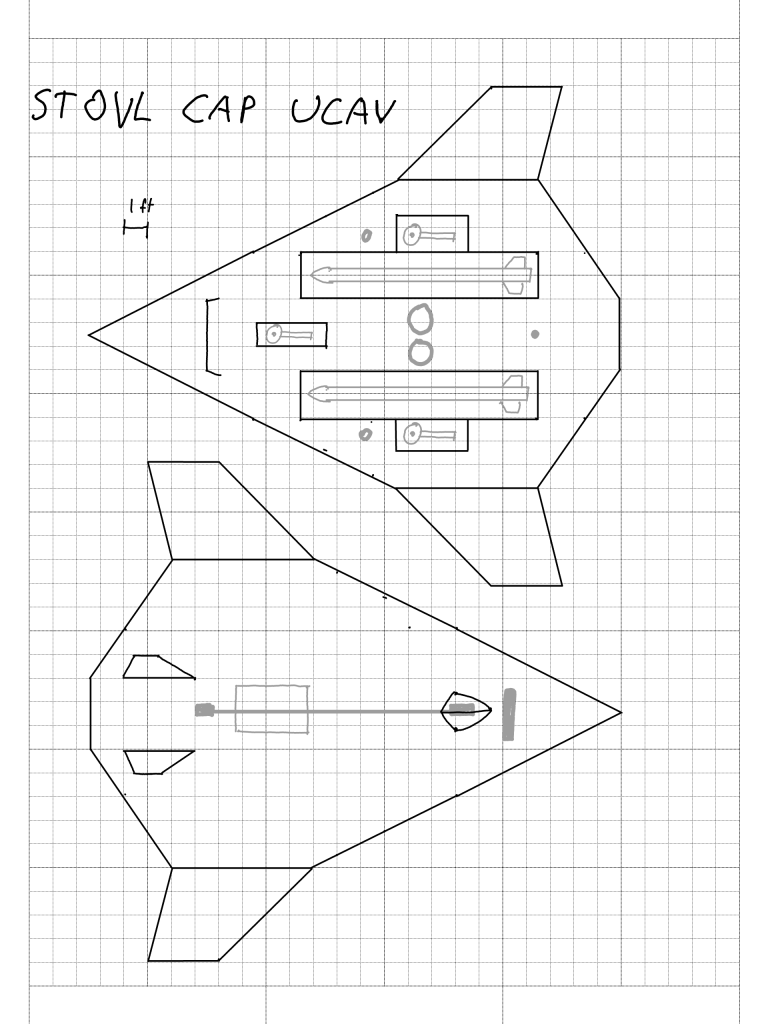
The basic design would be about 10k lbs, half the weight of an F-16, with a thick double delta flying wing to fit everything internally. I would skip the afterburner to save weight, but design it for efficient super cruise at Mach 1.4 to chase down Mach 0.95 cruise missiles. To facilitate service on naval ships and at austere bases, I would give it folding wing tips and use its powerful engine for a direct lift STOVL system.
For sensors, I would want a scaled-down version of the F-35’s suite with a radar, DAS, IR-EO telescope, and ELINT suite. That gives it good situational awareness and target ID capability for area air defence, even when dedicated AEW isn’t available.
Its main weapon would be the dorsal 35mm airburst cannon. Placed on top, with the muzzle where a manned fighter would have a canopy, keeps the muzzle gases out of the inlet, and lets it run the full length of the plane without interfering with the STOVL nozzles. I would also arm it with a pair of internal AIM-120s or AIM-260s for engaging enemy aircraft at long range in its role as an air defence fighter.
Other Thoughts
The nature of the programmable airburst rounds also has some potential for effective gun-based close air support from a jet without the A-10’s notorious fratricide issues. It would let you come in from behind instead of the side, where there’s much less chance of a stray bullet hitting friendlies, while still covering a useful area. I imagine something with cheek-mounted cannons, like the F-8, with a little built-in horizontal spread, would do pretty well.
A lighter 30mm programmable airburst cannon might make more sense than the old M-61 Vulcan as the cannon armament on manned fighters. It has a longer effective range against anything F-16 size or smaller, and is much more effective against any lightly armored ground targets.
 Matthew's Eclectic Engineering
Leave a comment