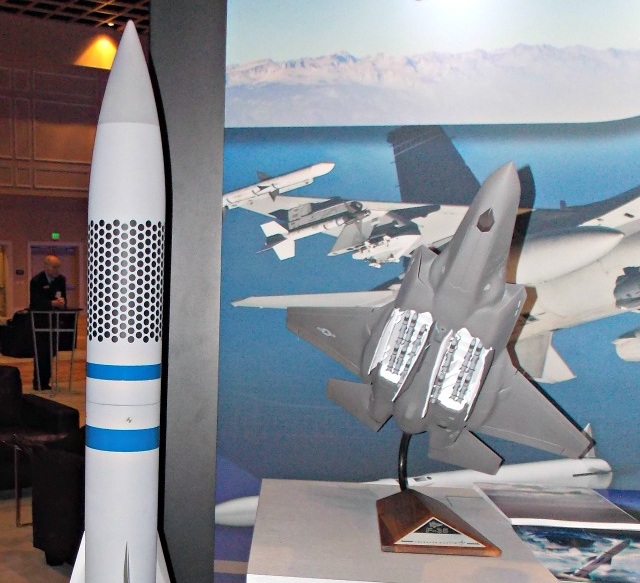
Image from Dave Majumdar/Flightglobal
https://www.flightglobal.com/fixed-wing/2013/02/details-emerge-about-lockheeds-cuda-missile/
The CUDA Missile
The Small Advanced Capability Missile (SACM) Program’s Goals
Due to the need for internal weapons bays, stealth fighters generally carry a lot less ordinance than their non-stealth counterparts. The F-22’s standard loadout has 6 AMRAAMS, compared to the F-15C/D’s standard loadout of 8. Combined with the F-22’s comparatively small fleet size, with 1/4 as many aircraft as the F-15C/D fleet, that doesn’t give the offensive counter air fleet much magazine depth. With the expectations of both utterly dominating the air and fighting outnumbered, it looked like the F-22s would run out of missiles before they ran out of fuel on most missions in a real air war.
To solve the shallow magazine depth, the US Air Force wanted a smaller missile that could match the AMRAAM’s range while carrying twice as many missiles in the same weapons bay. That program was, quite straightforwardly, called the Small Advanced Capabilities Missile or SACM, and the contender that was almost fielded was Lockheed’s CUDA missile.
Lockheed’s CUDA Missile
To maintain the same range in a smaller form factor, Lockheed turned to the hit-to-kill technology developed for its Patriot PAC-3 missiles. The attitude control motors around the nose are significantly lighter than a useful blast fragmentation warhead, allowing you to get the same range out of a much smaller missile. The PAC-3 style design also means the fins can be smaller because they don’t need to do the terminal maneuvering on their own. Those smaller fins further reduce drag and allow the missiles to pack much closer together.
The CUDA missile has the same diameter as an AMRAAM, and about the same range as a C model, while being half the length and half the wingspan. That let it fit on a Small Diameter Bomb rack, which was already integrated with the F-22. With CUDA, the F-22 would go from 2 AIM-9s and 6 AIM-120s to 2 AIM-9s and 12 CUDAs, doubling its BVR missiles. Unfortunately, the only trade show picture I could find is of the F-35, but it illustrates the same magazine capacity advantage.
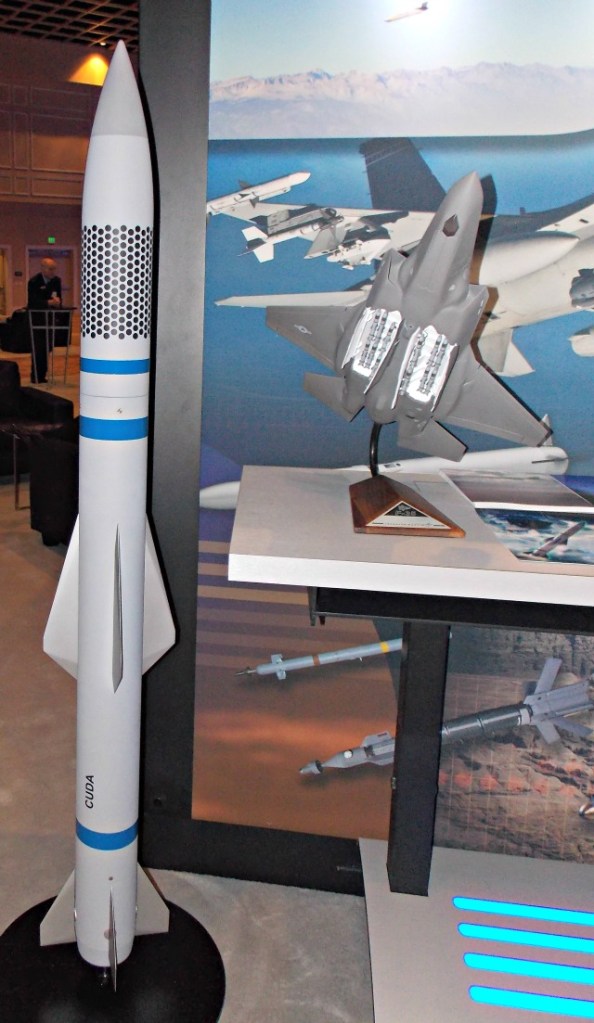
Image from Dave Majumdar/Flightglobal
https://www.flightglobal.com/fixed-wing/2013/02/details-emerge-about-lockheeds-cuda-missile/
Why CUDA/SACM was Abandoned
Despite the extra magazine depth and relatively low-risk design, the SACM program and CUDA missile were eventually abandoned without any production missiles. With some informed speculation, I suspect one of the major drivers of that cancellation was the increasing capability of the Chinese Air Force (PLAAF). With an increasing capability to target stealth fighters and longer-range air-to-air missiles, range became more important than magazine depth for countering the Chinese air force. That led to multiple programs, including the now-in-production AIM-260, to field longer-range air-to-air missiles from existing American stealth platforms.
I think the other problem CUDA ran into as an offensive counter-air weapon was that hit-to-kill just isn’t that effective against a full-size jet fighter. Even for a patriot battery, they typically keep some PAC-2s around for enemy aircraft, even though it takes up 3x the space, and PAC-3 is a much bigger missile than CUDA. Hit to kill just struggles to do fatal damage to a full-size jet fighter unless it gets lucky and hits a weak point, which its radar resolution isn’t good enough to aim for specifically. It’ll certainly mission-kill an enemy aircraft, but not being able to reliably prevent it from launching its own munitions is a fatal flaw for a missile meant for offensive counter-air.
The Missile Defence Cost Problem
Patriot is Expensive
One of the important metrics for air defence in any significant war is the short exchange ratio, meaning how much you spend to intercept a missile relative to its cost. Because sometimes things just miss, and a significant fraction of offensive munitions are going to be destroyed on the ground, the cost exchange ratio doesn’t have to be 1:1 to be sustainable. Especially for a wealthy nation like the US, I would ballpark a shot exchange ratio of between 2:1 and 3:1 as sustainable in the long term.
Patriot’s primary missile defence interceptor is the PAC-3 MSE missile. The domestic price for the US is about $4M each. Given that you need 2 missiles per intercept for most targets, that’s about $8M per intercept. That only gives you a sustainable shot exchange ratio against the top-end American missiles. Against cheaper weapons, just buying enough interceptors to last long enough starts to be a problem.
Smaller missiles like PAC-3 CRI are cheaper, but require a lot more launchers and stockpiles to defend the same area because of their shorter range. That makes peacetime sustainment more expensive and makes strategic mobility harder. Given that you aren’t intercepting missiles most weeks, the increased sustainment cost tends to cancel out the reduced procurement cost.
Why the West Relies on Combat Air Patrol
For western militaries, ground-based air defences aren’t the only option. While PAC-3 MSE costs $4M each, AIM-120 AMRAMMs are only about $1M each. AIM-120s are also employed by tactical jets, which, in contrast to Patriot launchers, can fly each sortie to different locations hundreds of miles apart on the same day. That makes AIM-120s much cheaper than PAC-3s, and more able to be where you need them, when you need them, on short notice. The downside being, the sustainment cost to keep those planes in the air is too high to keep them up waiting for an attack when there isn’t anything to intercept.
That being said, the number of intercepts per day to justify the sustainment cost is surprisingly low. The F-16 costs ~$20k / flight hour, and each one carries 6 AIM-120s. To match a typical Patriot battery’s 32 missiles, you need 5 planes airborne with a little rounding, which would cost ~$2.5M per day. If you fire two AIM-120s for one intercept every other day, that pays for the flight hours relative to Patriot PAC-3.
The Limits of Existing Air-to-Air Missiles
Unfortunately, existing air-to-air missiles just can’t intercept everything. AIM-120 and AIM-9 are limited to 30-35gs to hit tactical aircraft, while air defence missiles meant to shoot down other missiles can pull 50+gs to hit smaller, faster targets. That means that they’re really only effective against subsonic and low supersonic cruise missiles. Against even just rocket artillery, let alone higher-tier ballistic missiles or maneuvering supersonic missiles, existing air-to-air missiles are just not effective air defence. That brings up the question of: why not build a purpose-built, cheap air-launched air defence missile?
A Tangent about Israeli Air Defences
The obvious counterpoint here is that the Israeli David’s Sling Stunner missiles are only ~$750k and can shoot down ballistic missiles at longer range than PAC-3 MSE. The first thing to make the comparison more fair is that Israel has a purchasing power parity multiple of about 3.75, and very localized missile production. An American or Western European-built Stunner would probably cost ~$2M, roughly in line with the similarly sized PAC-3 CRI or ESSM, and still more than an AMRAAM.
To get more range out of a smaller and cheaper missile, it’s very specialized in a way that’s less useful to most other militaries. Its two-stage design gives it a minimum range of 40km, and using purely aerodynamic hit-to-kill limits its interception altitude to under 15km. While that dramatically increases its range and speed, a David’s Sling launcher can’t defend itself against ballistic missiles. That makes it great for defending Tel Aviv, but not so great at defending a military base. Its controls also aren’t quite as responsive as PAC-3 or Aster missiles, limting it’s ability to hit higher-end maneuvering re-entry vehicles or longer-range ballistic missiles.
CUDA for Missile Defence?
A Small Missile for Small Targets
Unlike against full-size jets, hit-to-kill with a small missile like CUDA is more than enough to pulverize another missile. While its small size turned out to be a weakness for offensive counter air, for missile defense, where targets are smaller, and ranges are shorter, it’s a huge advantage. Because CUDA fits in an SDB rack, most fighters can carry 2-4x as many CUDAs as AMRAAMs. With more specialized racks or weapons bays, the multiple could be up to 6x.
That small size also makes CUDA significantly cheaper. For anti-aircraft missiles with broadly similar design heritage and technology, cost scaling linearly with mass is a surprisingly good estimate. With the same motor diameter as an AMRAAM and half the length, CUDA should be about half the mass at 150lbs. Based on the 700 lb PAC-3 MSE being $4M and the 500 lb CRI being ~$3M (guess for domestic price since the US doesn’t buy them anymore), that would make $750k a reasonable estimate for the cost of CUDA.
Air Launched Terminal BMD
With the CUDA’s PAC-3-derived hit-to-kill design and attitude control motors, it has the maneuverability to hit a ballistic missile, given the speed and altitude to reach it. Given the SACM program’s requirement to match the range of an AIM-120C, a CUDA launch at speed and altitude should have the same range as a sufrace launched PAC-3 MSE. That level of performance, combined with its small size, would make air-launched ballistic and hypersonic missile defence practical.
Cost Comparisons
With a cost of $750k per missile and $1.5M for a typical intercept, CUDA could sustainably defend against much lower-end ballistic missiles than Patriot. $1.5M per intercept is almost cost parity with the $1.2M ATACMS TBM, and is therefore probably sustainable against the cheaper Chinese and russian equivalents. That low cost also means that you could justify 4 interceptors per target against challenging maneuvering re-entry vehicles while still achieving cost parity.
Also important is how the cost of maintaining a Patriot equivalent combat air patrol compares to Patriot or AMRAAM-equipped fighters. Using only the SDB racks that the F-16 is already set up for, it goes from 6 AMRAAMs to 2 AMRAAMs and 16 CUDAs. That takes you from 5 to 2 aircraft to match a Patriot battery’s magazine, and brings the sustainment cost down to $1M/day. A single shootdown per week pays for that sustainment cost relative to a patriot battery. CUDA could also be carried 12 each by some of the larger CCA concepts like the Shield AI X-Bat or Lockheed Vectus, giving a path to bring that cost down even further.
Some Creative Uses for CUDA-based Missile Defence
On the ground, CUDA’s small size allows it to fit in the mini VLS designed for Hellfire or JAGM missiles on trucks and patrol boats, and there is an army initiative to field a similar missile for it’s missile based SHORAD system. While its range and altitude capability from the ground aren’t significantly better than MANPADS, it could hit low altitude cruise missiles within 1.5km from a vertical launch cell and could provide some point defence against ballistic missiles.
The ability to hit maneuvering ballistic missiles would also imply the ability to hit long-range anti-aircraft missiles. Given how small and light CUDA is, it would be reasonably practical to put them on high-value air assets like AEW and EW aircraft that can’t really do stealth. That would give them an organic missile defence capability not so different from a naval destroyer, and make them much more survivable in a high-end conflict.
 Matthew's Eclectic Engineering
Leave a comment