Designing a Tug and Depot System
Why Use an Earth Departure Tug
The basic idea of an Earth departure tug is that you can do a 3km/s burn in Low Earth Orbit without actually escaping Earth’s gravity. That means that a tug which pushes a spacecraft onto that highly elliptical orbit can provide 3km/s of Delta-V and then return to Low Earth Orbit. The spacecraft it pushed can then finish its Earth ejection burn or lunar orbit insertion.
As launch costs come down and the cost of rocket hardware in orbit starts to matter more than just the cost of launching the fuel, reducing the amount of expendable hardware matters. A tug with a 3km/s Delta-V is about the same size as the spacecraft it’s pushing, so the amount of hardware leaving Earth is cut in half. It also lets you add a stage that’s easy to reuse for fully reusable missions beyond Earth.
The Three Burn Departure Depot
My idea for a flexible earth departure tug system is largely inspired by and an extension of this paper, from just a depot to include a tug that performs the first burn in the 3 burn departure sequence.
RAAN-Agnostic 3-Burn Departure Methodology for Deep Space Missions from LEO Depots
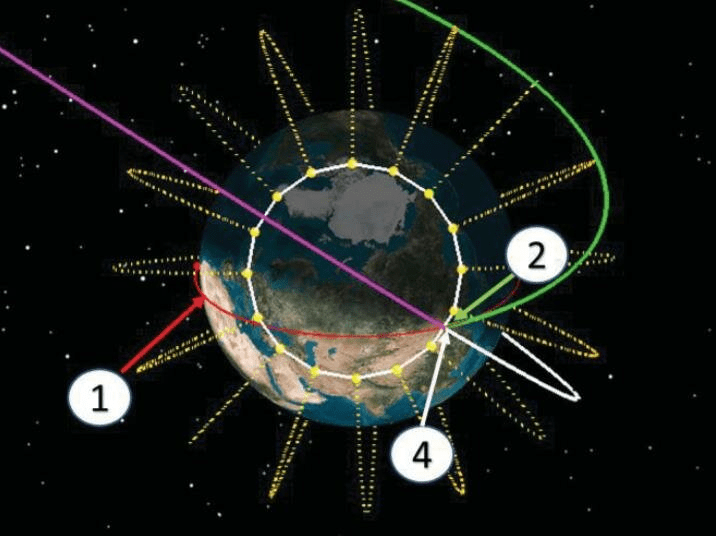
For any given Earth departure velocity, there is a family of hyperbolic orbits, the dashed yellow lines, that get you there. Because those orbits curve inwards as they leave Earth, there are many points, the central white ring, where you can start your Earth ejection burn, depending on the direction of your orbit. The key insight for the 3 burn departure is that once you’re on a very long elliptical orbit, tilting that ellipse is almost free. That means that as long as the depot’s orbit crosses the ring of possible ejection burn locations, you can go into a very high elliptical orbit with your perigee at the crossing point, and then cheaply turn your orbit to face the right direction for when you come back around to finish the Earth ejection burn. That allows one depot in an ISS orbit to refuel missions going to almost any destination in the solar system.
Adding the Earth Departure Tug
My innovation would be to add a tug that does the first burn of the 3 burn departure and then returns to the depot to do the same for the next mission. For returning missions, that same tug would be capable of meeting a returning empty spacecraft in high elliptical orbit and bringing it back down to Low Earth Orbit. That represents a significant reduction in expendable hardware for a one-way mission or a significant reduction in single-stage Delta-V for a reusable one.
Case Studies
All Chemical Propulsion Manned Mars Mission
A mission from Low Earth Orbit (LEO) to low Mars orbit and back takes 12km/s of Delta-V. No chemical, or even nuclear thermal, rocket can achieve that in a single stage, let alone with a meaningful payload. Shortening the travel time from 9 months to 6, as is often proposed for a manned mission, increases that to 16km/s of Delta-V. Even electric propulsion doesn’t help much because losing the Oberth-Effect triples the required Delta-V, erasing the efficiency advantage. Aerobreaking and aerocapture are generally considered too slow and too risky for a crewed mission, respectively, so you can’t sidestep the Delta-V problem that way.
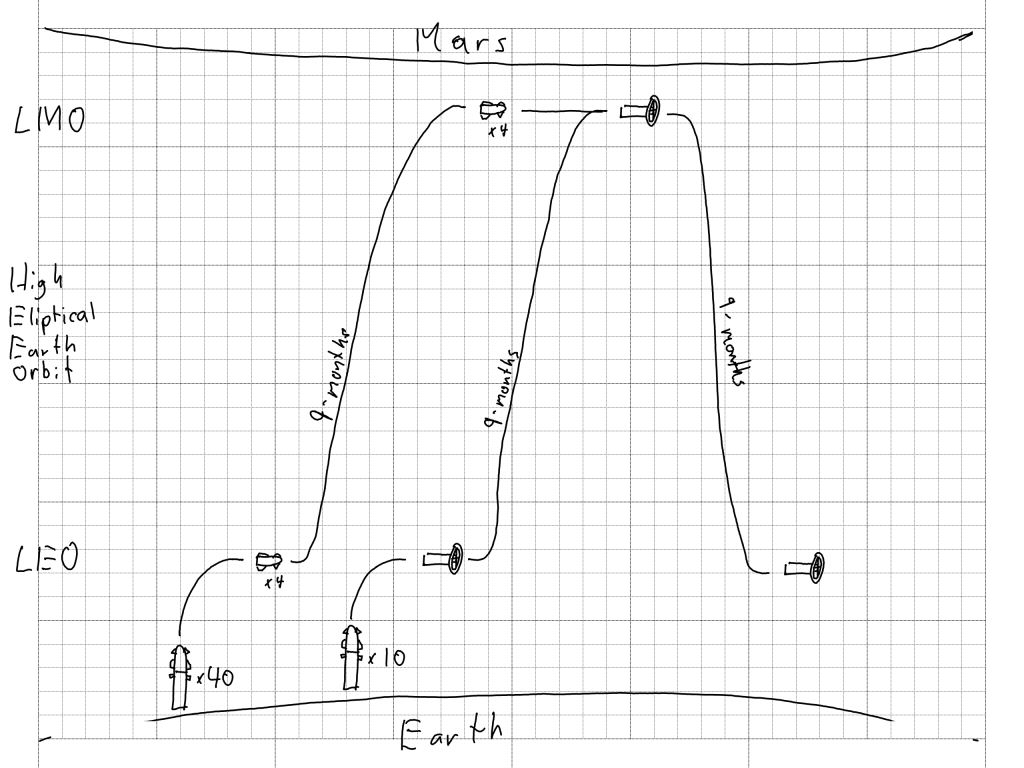
A reasonable and conventional starship V3-based architecture would require all cargo deliveries to be one-way trips, and would require significant starship tankers to be expended staging fuel in Mars orbit for the crew return. Assuming it takes 10 tankers to fully refuel a ship, and the habitat is 100 tons, a 9-month travel time would require staging ~4 starship tankers worth of fuel, and a 6-month travel time would require staging ~8. Even for the cheaper 9-month travel time, that’s 40 tanker launches to LEO, 3 of which are expended going to Mars, to get the crew there and back. A 6-month travel time takes 90 tanker launches, 8 of which are expended.
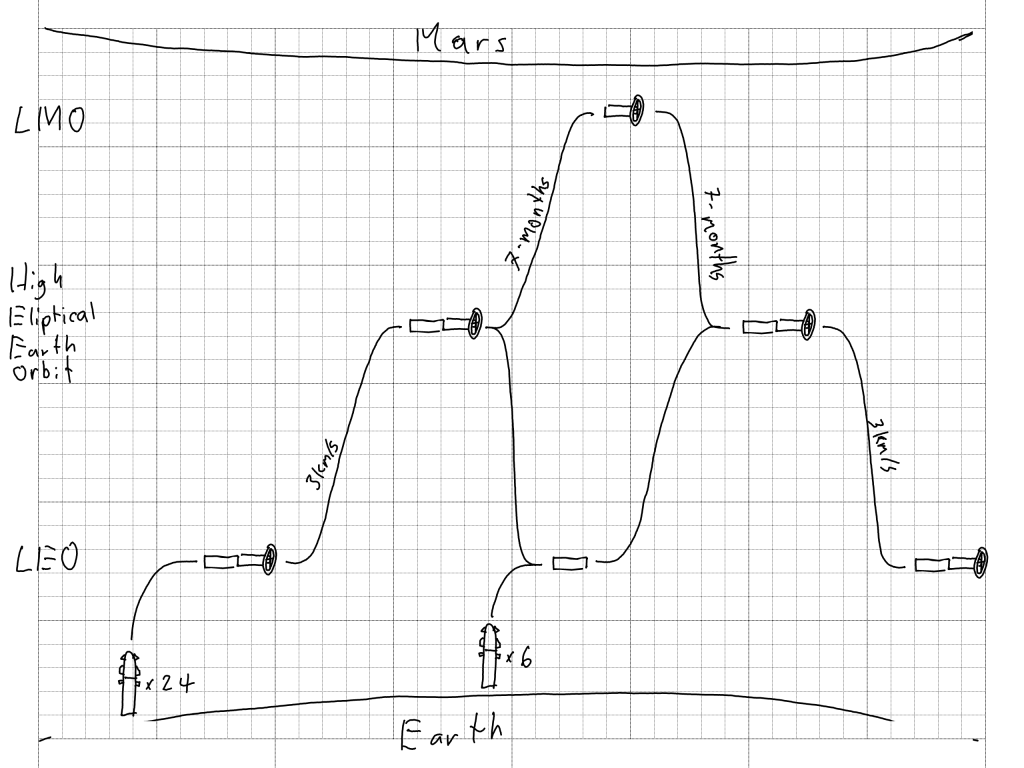
With a tug that can provide the initial 3km/s of the ejection burn, and the last 3km/s back down from the elliptical capture orbit, a 9-month travel time only requires 6km/s from the interplanetary ship. That’s well within the capabilities of a high-performance chemical stage, and a fully reusable space-only V3 starship could reasonably deliver 600+ tons to Mars orbit or carry a 200 ton heavily shielded habitat both ways and 200+ tons of cargo. That would only take ~30 tanker launches to LEO with nothing expended. A space-only V3 starship with a 100 ton habitat would have 9km/s of Delta-V, which is enough to manage a 7-month travel time with the Earth departure tug architecture.
Lunar Surface Missions
A mission from LEO to the lunar surface and back also requires about 12km/s of Delta-V. Using the Earth departure tug to get to and from the Moon is going to have very similar performance to a lunar orbit rendezvous architecture. Either nets you about twice the payload to the surface for every kg of fuel launched to LEO, compared to the current insane single-stage starship HLS, without having to use aerobreaking. The advantage of using an Earth departure tug instead of a standard lunar orbit rendezvous is that the tug can go do other missions while you’re on the Moon, making it a better infrastructure investment.
Uranus Orbiter Mission
My last case study is going to be a robotic exploration mission, in this case, a Uranus orbiter, because it was my senior design project. The Johns Hopkins APL design for the 2023 decadal survey is an 8-ton spacecraft that has 2.5km/s of Delta-V for Uranus orbit insertion and visiting the moons. With launch vehicles that are already flying, the mission requires a fully expended Falcon Heavy to get the required C3 of 30 with a 4.5km/s ejection burn from LEO. Launching on a reusable starship in the hopefully near future, an approximately 40-ton expendable kick stage for the ejection burn after Starship drops it off in LEO.
For a mission designed around an Earth departure tug, it only needs an extra 1.5km/s for the Earth ejection burn. Adding that to the 2.5km/s needed at Uranus, is 4km/s, which is reasonably achievable in a single stage, even with storable propellants. That takes the single-use hardware from an 8-ton spacecraft and a 40-ton kick stage to a stage spacecraft weighing about 20 tons. That easily cuts the transportation cost to Uranus in half, even compared to Starship with a kick stage, giving even more freedom to design a heavier and cheaper mission, or to design for higher Delta-V for a shorter transit time.
Why it Matters
Exploration in all its forms, the need to seek out new frontiers and new questions waiting to be asked, is part of what makes us human. Space, and finding our place in the cosmos, is that great frontier we can explore, but the harsh conditions and the tyranny of the rocket equation make that extremely challenging and expensive. There’s a reason that it’s taken 50 years of technological development to even try to replicate the accomplishments of the Apollo program without Cold War military budgets and risk tolerance. Exploring space on a grander scale isn’t going to just be about technical cleverness or brute force; it’s going to be about building infrastructure. This is one of those pieces of infrastructure, along with reusable rockets, that is going to make that exploration affordable.
 Matthew's Eclectic Engineering
Leave a comment