Why It’s Important
Climate Impact
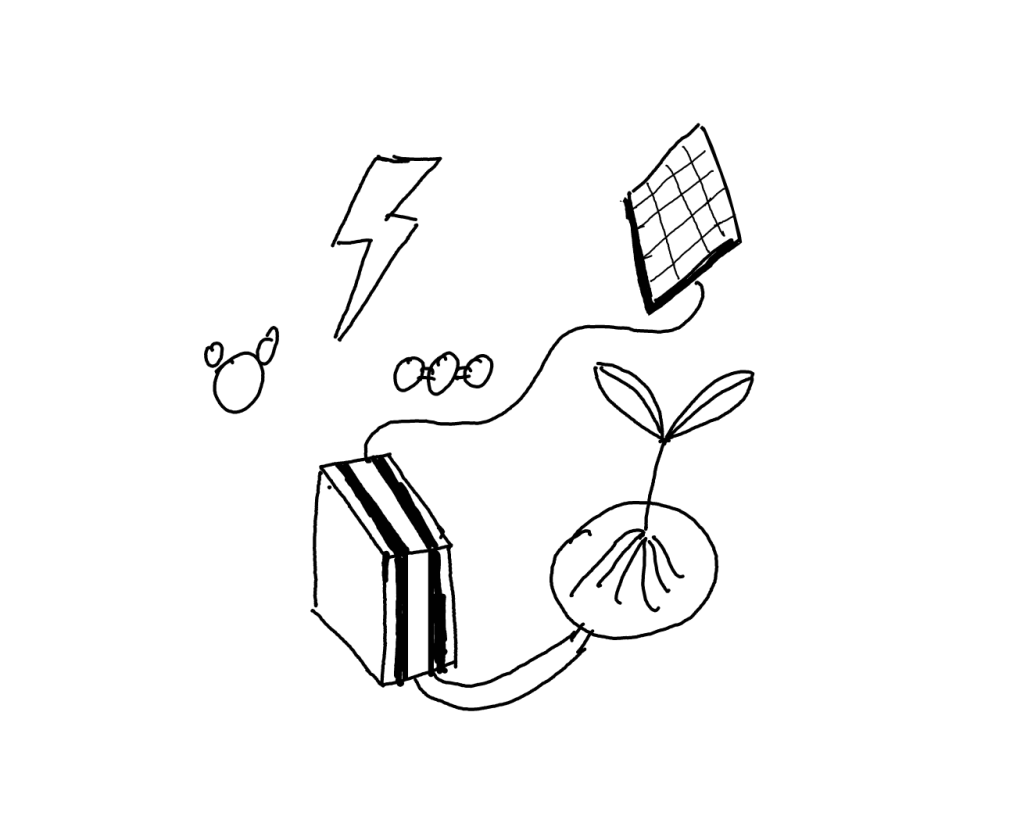
Electro-agriculture is a term coined by (AUTHORS OF PAPER) for a system that makes food using electricity and doesn’t involve any photosynthesis. Instead, electrolysis is used to create simple molecules to feed plants, fungi, and microbes in bioreactors and vertical farms. That uses dramatically less land and water than conventional agriculture, which reduces land use change and transport emissions, and could free up land for re-wilding.
Food System Resilience
Electro-agriculture systems are controlled indoor environments that can be built anywhere and are very water-efficient. That lets food production be localized even in places that can’t support traditional farming, building resilience for natural and unnatural trade disruptions. It also builds resiliency for the whole food system against an increasingly unpredictable climate with more droughts, floods, and extreme weather.
Living in Space
For living in space, a food system that doesn’t require access to sunlight or use inefficient LED driven photosynthesis would be a game changer. A compact and highly productive bioreactor or aeroponic farm is easy to shield, and electro-agriculture can make efficient use of solar panels or nuclear reactors to power them. That represents a massive weight and volume savings over the alternatives, making space exploration that much easier.
Near-Term Products
Commodity Protein (Solar Foods Solein)
One of the few electro-agriculture-related products that’s already starting to scale is an alternative protein called Solein from Solar Foods. They’re growing a strain of deep-sea microbes using electrolytic hydrogen as the energy source, which are 78% protein when dried and have a neutral taste. It can substitute for things like soy or whey protein in industrial applications, processed foods, and animal fodder. Solein is also a pretty good emulsifier, so it can substitute for powdered eggs or dairy proteins in some applications. Solar Foods claims that they can produce Solein for $2/kg once they scale up fully, potentially undercutting soy protein.
https://solarfoods.com/solein/
https://gastropod.com/yes-you-really-can-make-food-from-thin-air-and-we-tried-it/
https://www.youtube.com/watch?v=1Bphnj4xMPc
Commodity Saturated Fats (Savor)
The other ready-to-scale electro-agriculture adjacent product I’ve found is saturated fats from Savor, like butter and light oils. It has a potentially huge impact. They make fully custom saturated fats that can replicate anything from specific batches of butter to regular vegetable oil. That process control gives a higher quality product than you can get from natural sources, and can replace some of the most polluting parts of conventional agriculture. Like Solar Foods, Savor claims competitive commodity prices once they scale up, and have backing from a lot of big names, from Bill Gates to United Airlines (diesel fuel is very similar to vegetable oil).
https://www.savor.it/
https://gastropod.com/yes-you-really-can-make-food-from-thin-air-and-we-tried-it/
The Potential of Acetate Electrolysis
What is Acetate Electrolysis
The technology that would extend electro-agriculture to most of the food system in the future is making acetate through electrolysis instead of fermenting starch. Acetate is a common feedstock for precision fermentation and bioreactors to make specialty bio-molecules from flavorings for pharmaceuticals.
The process first splits water electrolytically into hydrogen and oxygen. Then the hydrogen is fed into a second electrolysis cell that preferentially converts it to acetate. The whole process converts about 60% of the electrical energy to chemical energy. That has the potential to be dramatically cheaper and more efficient than conventional acetate production, and be good enough to grow food with it.
Electro-agriculture: Revolutionizing farming for a sustainable future – Bradie S. Crandall, et al
General Precision Fermentation
Precision fermentation is how we make many pharmaceuticals from insulin to monoclonal antibodies. It’s also used to make certain food ingredients like chymosin for cheese making or many B vitamins. The dramatically shorter and more efficient process to produce electrolytic acetate as a feedstock would make precision fermentation cheaper and competitive for a much wider variety of molecules. It would also open it up to space systems, where starting from starch crops to produce acetate is much harder.
Commodity Refined Starch
Some strains of Chlorella are efficient acetate fed startch producers, with current strains achieving about 50% starch. Based on the Solein price target and some extra efficiency losses in the chlorella process, I’d expect $4/kg of starch, though the selling price might be lower if you also get some useful proteins and unsaturated oils out of it. You could use it for refined starch or supplement it with specific proteins to make substitutes for various flours.
This is probably not a viable commodity on earth without subsidies, since most grains trade at ~$0.20/kg and refined corn starch is $2/kg. On the other hand, it is cheap enough to be a useful hedge against compounding crop failures or trade disruptions for wealthy nations that can afford some subsidies or to maintain slack capacity. Once we move to space, that’s probably dramatically cheaper than any attempt to grow conventional grains.
Vertical Farms that Actually Work
The great unfulfilled promise of vertical farms is to grow high-quality produce close to where it’s sold, year-round, anywhere in the world. That would eliminate long cold chains for shipping, making the system more efficient and resilient, and allowing it to grow varieties that are better food but don’t tolerate shipping well. In practice, energy is the largest cost in vertical farming, and anything other than leafy greens just takes too much energy to grow with artificial light to be competitive.
Most plants can use acetate to grow when their seedlings, and with some relatively straightforward genetic engineering, we can develop varieties that preserve that ability in adult plants. Once you have produce that can grow on acetate, you can switch from grow lights to electro-agriculture. That means less wasted energy and less heat to be removed, using less than one-tenth the energy to grow the same plants. That is how vertical farming can achieve the energy efficiency to move beyond leafy greens to high-value produce. It also gives you a clear path to growing produce in space, for even an expeditionary crew, that’s independent of the sun.


Leave a comment