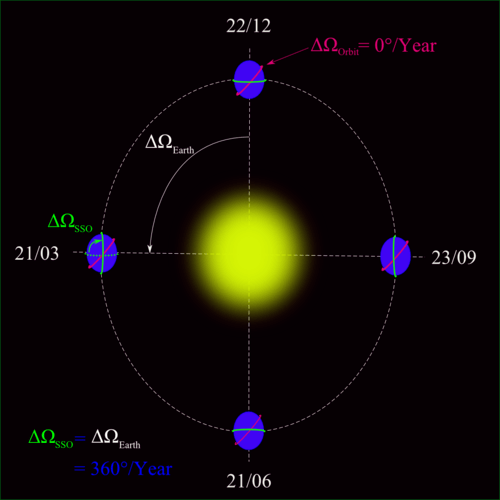
-Wikipidia Sun-Synchronous Orbit
Why Sun Synchronous
Hosting High-Value Earth Observation Instruments
One of the keys to making a space station more affordable, and potentially profitable, is to not just manage costs, but to maximize potential revenue sources. One of the valuable services the ISS has increasingly provided over time is hosting earth observation instruments. That’s cheaper than building a free-flying spacecraft and allows more instruments to be co-located. The ISS has also become a launch platform for cubesats using spare payload on resupply missions.
Sun-synchronous orbit is especially valuable for Earth observation because it flies over the same point on Earth at the same time every day. That makes it the orbit of choice for flagship missions from national space agencies and small sats on ride-share missions alike. One of the most valuable positions for Earth observation satellites is the 1:30 and 13:30 pass orbit occupied by the A Train satellites. Occupying that orbit would allow the station to host more and more valuable Earth observation instruments, and serve as a useful launch platform for more small-sats.
Increased International Access
Sun-synchronous orbit also has the potential for increased international access from new spaceports. It can be accessed from almost every legacy spaceport, including Cape Canaveral, and allows access from new high-latitude launch sites like Saxaford in the UK and Mahia in New Zealand. That allows access by more launch providers from more nations, driving competition and increasing sovereign access to the station.
How a Station Adds Value
Shared Bus Services
Most bus services get more efficient as they get bigger. Bigger solar arrays are cheaper and lighter per kW, larger propulsion systems are more efficient, large stations can use control moment gyros that are much more powerful than reaction wheels, and the bit rate from a phased array scales with the square of its area. It costs significantly less to provide bus services on a station than individual satellites, which leaves room to turn a small profit on hosting instruments. It also allows for more flexibility because a station can host instruments on an individual basis instead of having to assemble a full satellite.
A full station also has the scale to provide ancillary services like edge computing and data processing hardware onboard that dramatically reduce downlink requirements. As earth observation systems become more sophisticated and data-dense, that becomes even more important, and memory-intensive data processing needs large-scale computing to be handled efficiently.
Maintainance and Upgradability
Remote sensing technology advances quickly, and space-based sensors are often far behind the state of the art because replacing an entire satellite is just too expensive. Contrast that with something like the Hubble servicing missions that dramatically improved the capabilities of the telescope by replacing relatively small components. A station could do servicing and upgrades on the instruments it hosts, and revive the replacement parts much more economically on ride-share missions. With the right equipment, it could even do the same for satellites in nearby orbits that can rendezvous with the station, like telescopes that need better pointing accuracy than the station can support.
How I Would Design It
ISS Like Platform
For a large zero-gravity station with trusswork for mounting things away from the pressurized modules, it’s hard to do better than the core design of the ISS. The Sun’s synchronous orbit simplifies the solar panel wings because they only need single-axis tracking instead of two-axis tracking. The other major difference imposed by hosting earth observation instruments is that all docking ports for visiting spacecraft have to be on the zenith (outward-facing) side so that said spacecraft don’t block sensor fields of view.
Specialized Maintenance Airlock
One of the key features to increase the station’s value is dramatically improving the ability to do maintenance on externally mounted equipment. I think the best way to do that is to build a hybrid of an airlock and a cleanroom for maintenance. That would allow equipment to be brought into the airlock by the manipulator arm so that the astronauts can do maintenance without an EVA. That allows more complex and delicate work to be done more easily and without wasting the astronauts’ time dealing with space suits or pre-breathing for an EVA.
The system would be equally capable of working on free-flying spacecraft from nearby orbits that come to the station for maintenance. A module the size of a Starship or New Glen fairing could swallow the entire Hubble or Nancy Grace Roman space telescopes for relatively easy maintenance and upgrades.
3 Legged Manipulator Arm
I think another novel piece of equipment to complement the maintenance airlock is a 3-leg version of the ISS Canadarm. That would allow it to walk across the station while carrying something to move equipment between visiting spacecraft, instrument bays, and the maintenance airlock. It would also be capable of grappling two things while stationary, to more quickly and easily swap out modules for upgrades and replacements.


Leave a comment