Origins of the Debate
Prussian Officer Training
The Prussians invented modern war gaming in the early 1800s for officer training in the form of Kriegspiel. It was designed to give officers a chance to practice command without real battles or even the cost of field exercises. It was played with two opposing commanders with an experienced officer serving as an impartial referee. According to a good book on the history of TTRPGs, “The Elusive Shift” by Jon Peterson, even 200 years ago, the Prussians were already arguing about rules vs rulings in Kriegspiel.
Why Rules are Helpful
The biggest advantage of rules is that they’re precise and consistent. They reduce the need for judgment calls and the effect of biases from the referee, and make games more repeatable. Especially if you can’t count on having the best referee or have to switch referees regularly, that can make a big difference.
Why Rules Get in the Way
Rules can also get in the way of the game working well. Just having detailed rules to begin with can prime you to use the tools they give you instead of coming up with out-of-the-box solutions. It’s also impossible for the designer to account for the nuance of every situation, and detailed rules will always run into situations where they dictate an outcome that doesn’t really make sense.
Levels of Abstraction
What are Levels of Abstraction in TTRPG Rules
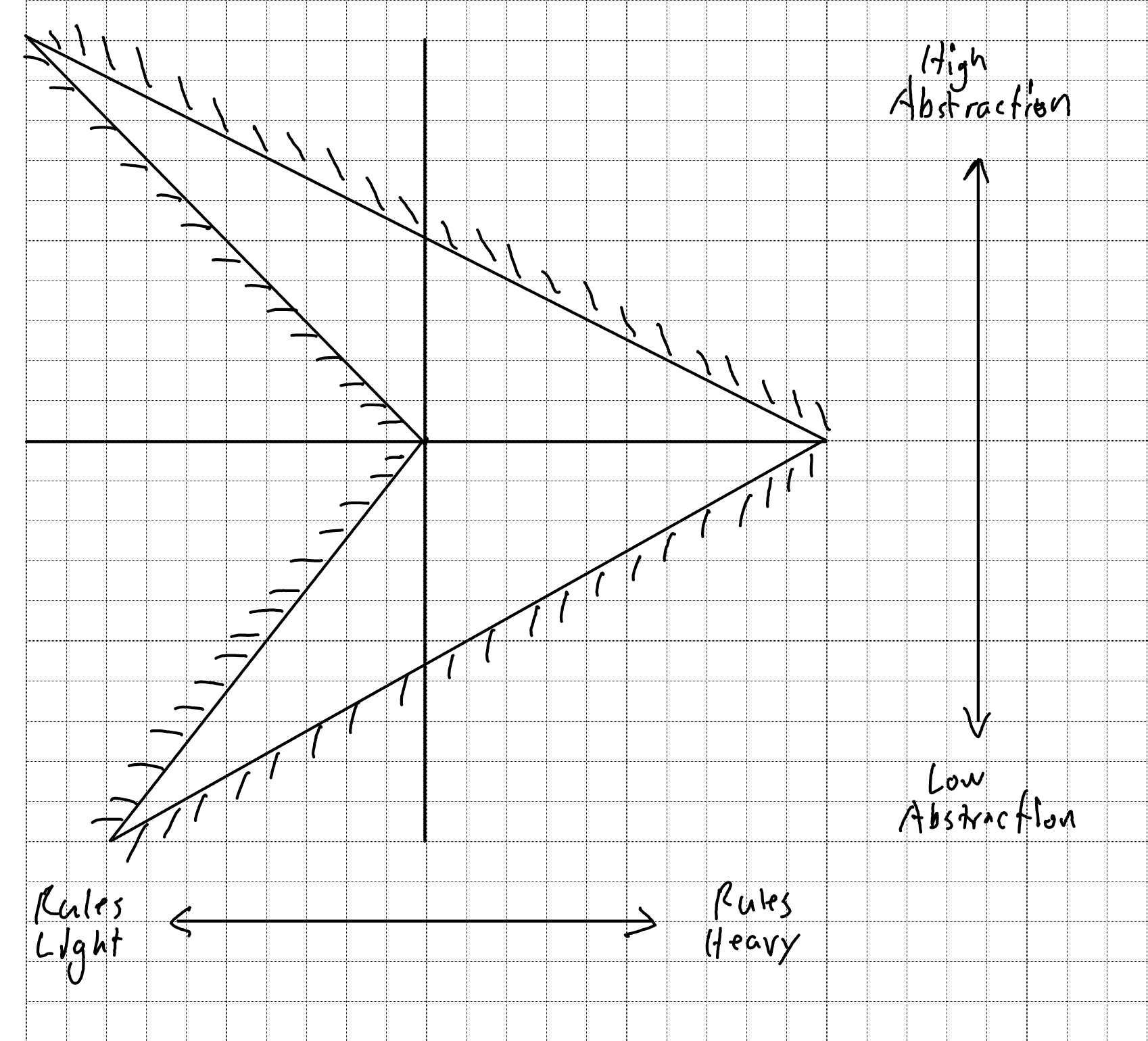
I think a related axis that’s rarely explored in TTRPGs is not just how exacting the rules are, but what level of abstraction they operate at. A more abstract system is going to use broad strokes to decide how good you are at something and settle for close enough. It’s also going to be relatively hard to disassemble an action or action sequence into component parts and rebuild them in a different way that still makes sense. A less abstract system is going to take a more granular approach and be easier to disassemble and reassemble. If you plot the level of abstraction and the level of rules detail, there is a limited area that works, but most games only explore the top half of it.
The Two Paths to Rules-Light
Almost all systems and their sub-games live in the top half of the plot, with increasing abstraction as they get simpler. You simplify by making each thing more general and not worrying about the details so much. I think there’s an alternative path to rules-light with low abstraction. Instead of simplifying by making things more general, you have a simple way to compose skills on the fly out of a set of relatively granular attributes. It’s not appropriate for every game, but it gives a lot more structure for a given level of flexibility and reliance on rulings, which makes it a really useful tool in the design toolbox.
Rules Heavy is Always Moderate Abstraction
Rules-heavy systems are almost definitionally moderate abstraction, because, like in so many things, that’s where the most complexity is. If you have too much abstraction, that hides a lot of the complexity, and makes it challenging to actually have very many rules or make them specific enough to be precise. It’s equally challenging to make something really precise with too little abstraction because the complexity becomes an emergent property instead of an explicit one. In between, there’s room to build a precise and comprehensive system of explicit rules.
The Social Dimension
Perceptions of Fairness
Unlike most wargames, in TTRPGs, the GM is both the referee and the opponent, which introduces an extra layer to the perceptions of fairness between friends. In more adversarial scenarios, like combat, it’s easy for things to feel unfair if the GM has more leeway to make rulings, even if those rulings are good. That can be a problem whether the players feel like they’re being beaten unfairly or feel like the GM is going easy on them. More precise rules can serve as a social “shield” and something easy to blame to smooth over those frictions. For a typical group, the more adversarial the situation, the more rules-heavy it needs to be to maintain perceptions of fairness and social cohesion.
Occupying a Range, not a Point on the Scale
There are real advantages to both rules-light and rules-heavy games. Rules-light gives you much more flexibility and lets you be more creative, while rules-heavy is more precise and repeatable, and can make adversarial subgames smoother. I don’t think there’s any good reason a system should try to fit in one place on the spectrum, and instead the designer should deliberately use a range of rules detail and abstraction to take best advantage of their tools for every sub-game.


Leave a comment